110 to 135 ton press brake: capacity, applications and buying guide
A 110 to 135 ton press brake sits in the mid class. Tonnage is the force the machine can apply, and...

A 150 to 175 ton press brake sits in the mid to heavy class. Tonnage is the force the machine can apply, and it decides how thick and how long a part you can bend. This guide covers what that force buys you, where these machines earn their keep, and how to choose the right size without over or under buying.
Bending force depends on thickness, bend length, material strength and die opening. As a rough air-bending guide for mild steel, with a die opening about eight times the thickness, a press brake needs roughly 7 to 8 tons per metre of bend for each millimetre of thickness. In practice a 150 to 175 ton machine handles around 6 to 7 mm mild steel over a 3 m bed, more on short bends. Treat that as a starting point and confirm with a tonnage chart.
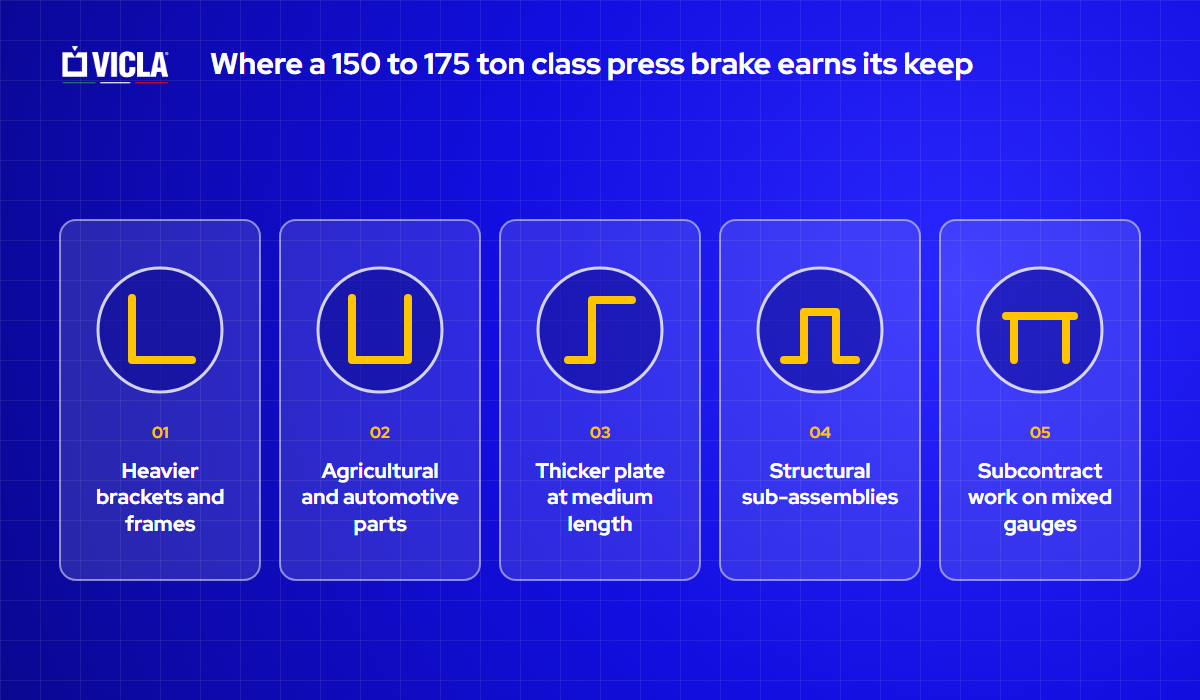
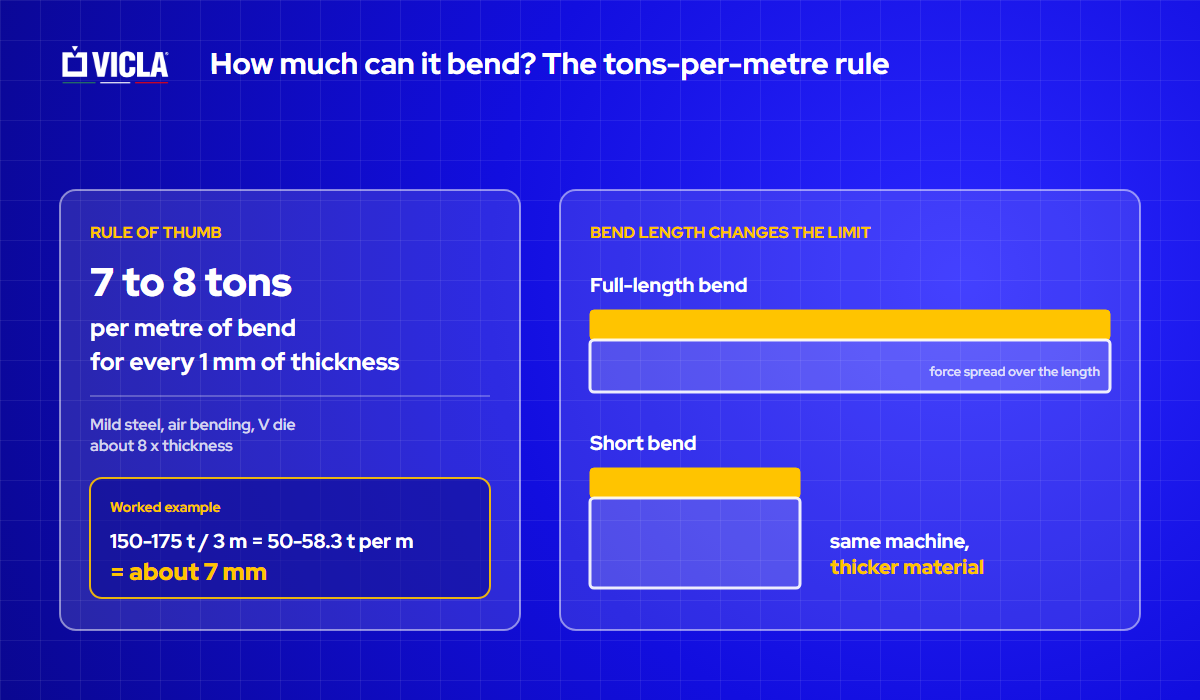
A machine in this class works comfortably in mild steel and stainless into medium-heavy gauge. Capacity falls on stainless, which needs more force than mild steel, and rises on short bends, where the force is concentrated. Die opening and punch radius matter as much as raw tonnage, so size the tooling to the job.
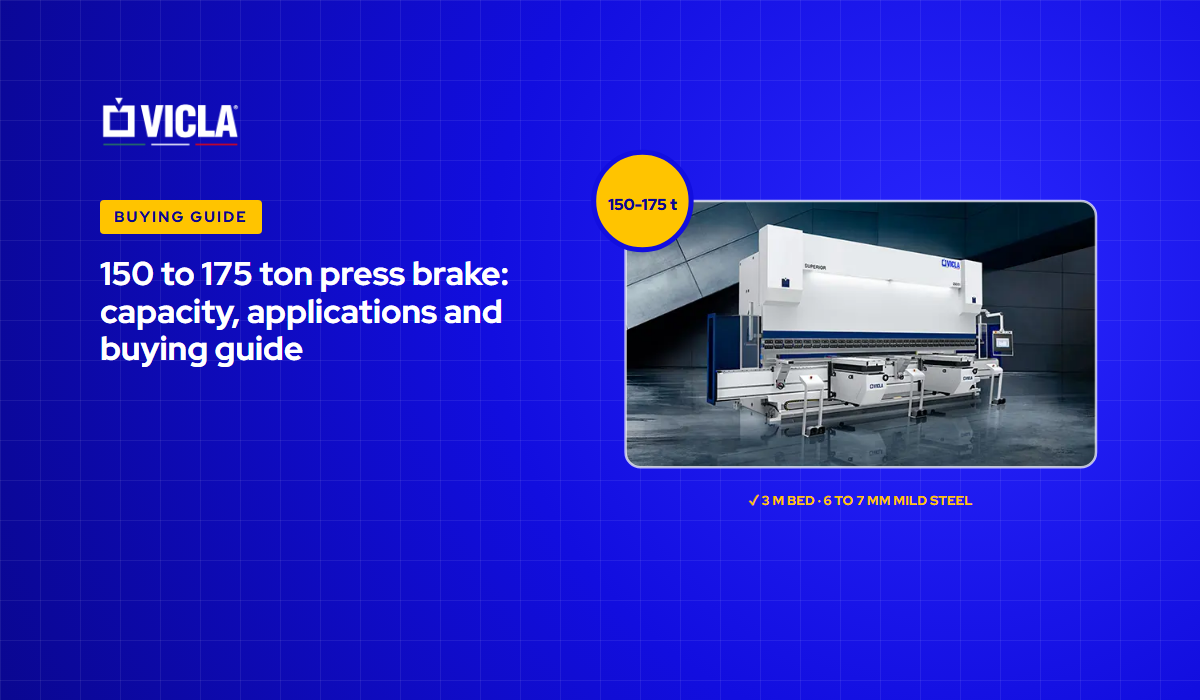
For this tonnage, look at the VICLA SUPERIOR hybrid range, which spans roughly 50 to 320 tons and 2 to 7 metre beds. Pair the tonnage with a bed length that fits your longest real part. VICLA also builds this tonnage in the value SMART line (110, 170 and 250 ton models).
VICLA machines in this class run the hybrid drive, which saves up to 55% energy (up to 78% on the Hybrid System Plus), and bend with real-time Clever Crowning, the Flex flexion-control system and L.A.C. laser angle control, for linear, repeatable bends even on long or non-uniform sheet.
Choose this band when thicker plate starts to appear regularly. If most work is still light, a smaller machine is cheaper; if heavy plate is the norm, look higher up the range. Start from your heaviest and longest real bend, add a sensible margin, and confirm the numbers with a tonnage chart or your VICLA contact rather than guessing.
As a guide, around 6 to 7 mm mild steel over a 3 m bed, more on short bends, in mild steel and stainless into medium-heavy gauge. Always confirm against a tonnage chart for your exact material, thickness and die.
No. Oversizing wastes money and gives no benefit on thinner parts, while undersizing limits the work you can take. Match tonnage to your real part mix.
Force is spread along the whole bend, so a longer bend needs more tonnage. The same machine bends thicker material on a short bend than on a full-length one.
A 110 to 135 ton press brake sits in the mid class. Tonnage is the force the machine can apply, and...
A 750 to 1000+ ton press brake sits in the extra-heavy structural class. Tonnage is the force the...
A 200 ton press brake sits in the heavy class. Tonnage is the force the machine can apply, and it...