
A guillotine shear sets the quality of every part downstream. Here is what actually matters when you specify one.
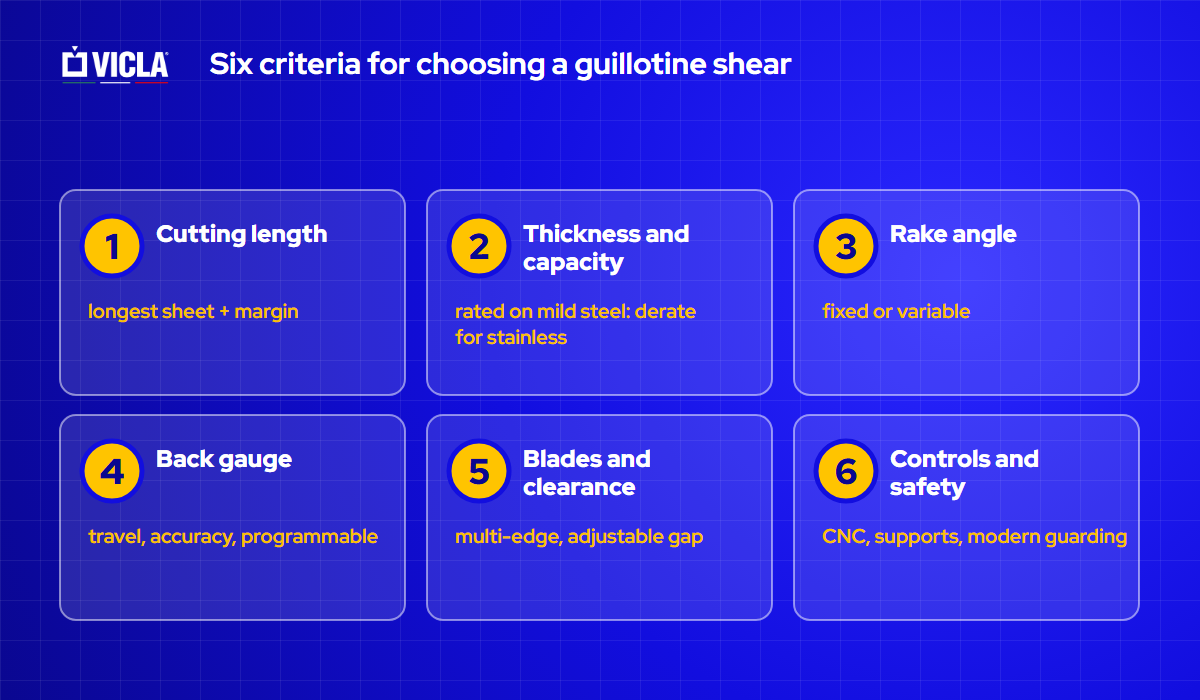
1. Cutting length
Match it to your longest sheet, plus a small margin. Too much length costs money and floor space; too little caps the jobs you can take.
2. Thickness and material capacity
Capacity is rated on mild steel. Stainless and high-strength steels need more force, so derate for them, and size for your heaviest real material.
3. Rake angle (fixed or variable)
A larger rake cuts thick plate with less force but can twist thin strips; a smaller rake keeps thin parts flat. A variable-rake shear lets you tune the angle to the material, which reduces twist and bow.
4. Back gauge
A motorised back gauge sets the cut width repeatably. Check its travel, accuracy, and whether it is programmable, because this is what turns a shear into a production machine.
5. Blades and clearance
Good shears use multi-edge blades you can rotate for long life, with adjustable clearance so you set the right gap for each thickness.
6. Controls and safety
A modern CNC control stores programs and speeds changeovers; sheet supports and squaring arms help handling; hydraulic drive brings it together with modern guarding.
The VICLA Diamond guillotine shear
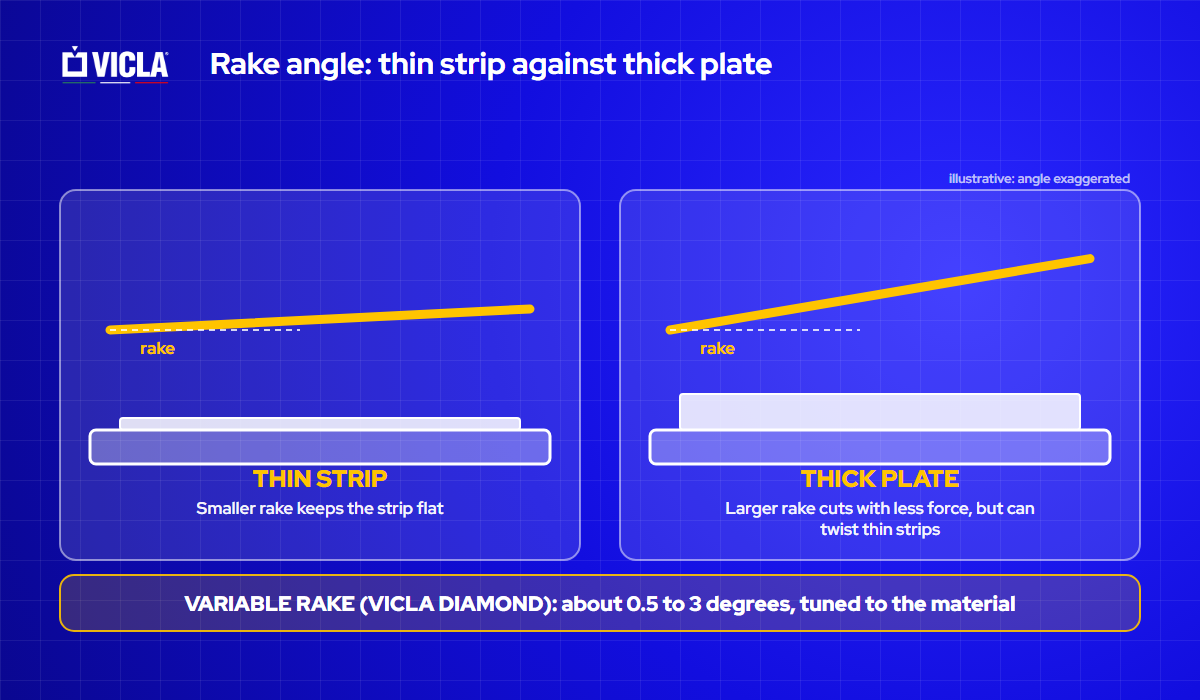
VICLA's Diamond is a hydraulic guillotine shear with a variable (adjustable) rake angle of roughly 0.5 to 3 degrees, so you can keep thin strips flat and cut thick plate with less force on the same machine. The range runs from 2 to 6 metre cutting lengths and up to 20 mm in mild steel (models from 4 mm). It uses auto-adjusting hydraulic hold-downs that match pressure to the material, a swing-away back gauge that retracts during the cut to protect accuracy, multi-edge blades with adjustable clearance, a LED cut line and CNC control.
How to size it
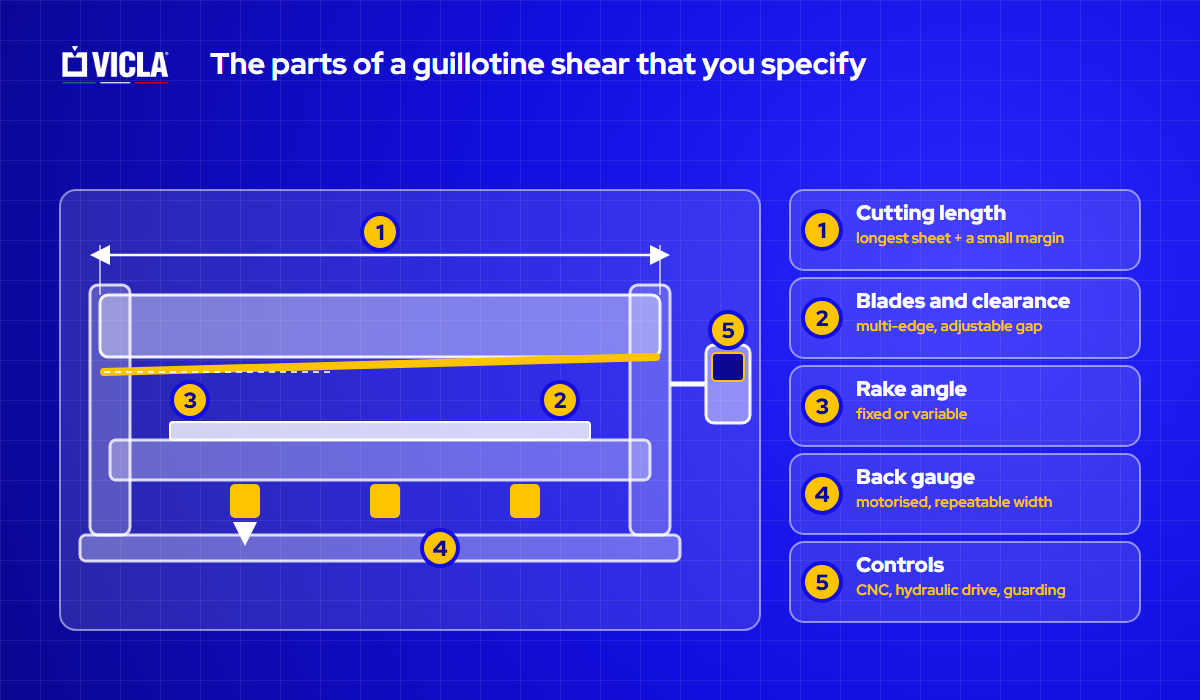
Start from your longest and thickest real sheet, cover it with margin, then choose variable rake and back-gauge travel for your material mix. The VICLA Diamond is built around exactly these priorities.
Frequently asked questions
What capacity do I need?
Size to your heaviest real material in its true grade, not the mild-steel rating alone.
Do I need variable rake?
If you cut a wide range of thicknesses or long thin strips, yes.
Is the back gauge important?
Very. It makes cuts repeatable and fast.