Robotic bending cell: the complete guide to components, costs and ROI
A robotic bending cell puts a 6-axis robot next to a CNC press brake and lets it load, bend and...

A 30 and 40 ton press brake sits in the light class. Tonnage is the force the machine can apply, and it decides how thick and how long a part you can bend. This guide covers what that force buys you, where these machines earn their keep, and how to choose the right size without over or under buying.
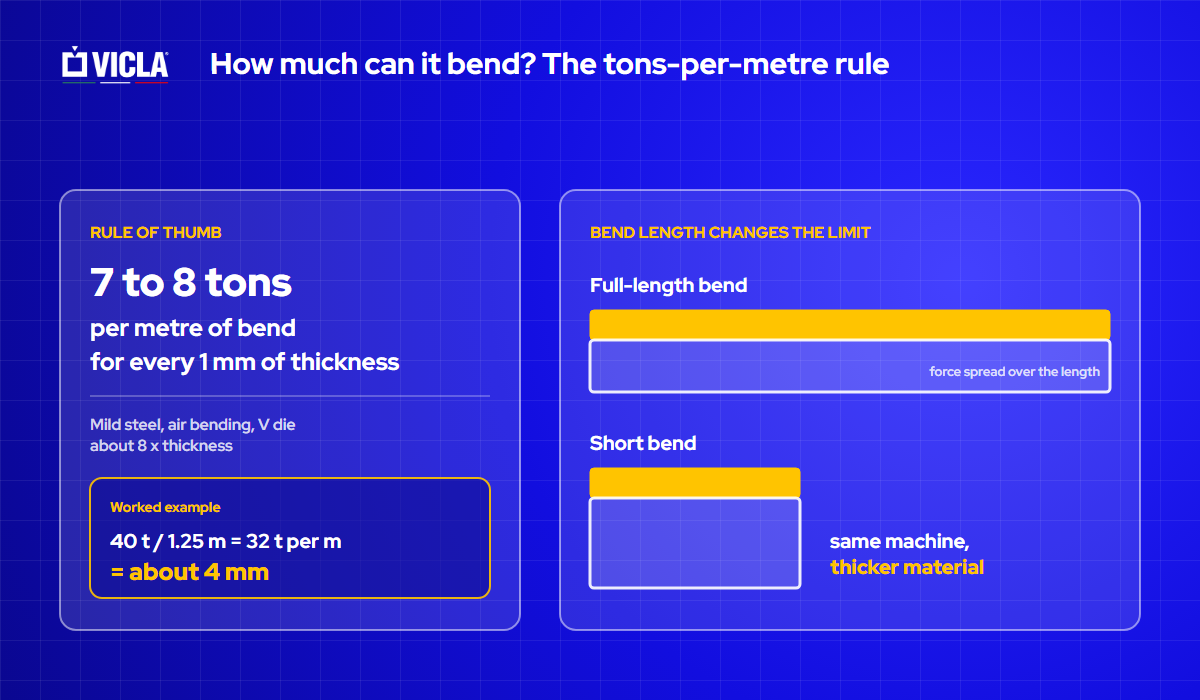
Bending force depends on thickness, bend length, material strength and die opening. As a rough air-bending guide for mild steel, with a die opening about eight times the thickness, a press brake needs roughly 7 to 8 tons per metre of bend for each millimetre of thickness. In practice a 30 and 40 ton machine handles around 4 mm mild steel over a short 1.25 m bed, and noticeably more on short bends. Treat that as a starting point and confirm with a tonnage chart.
A machine in this class works comfortably in thin mild steel, aluminium and light stainless. Capacity falls on stainless, which needs more force than mild steel, and rises on short bends, where the force is concentrated. Die opening and punch radius matter as much as raw tonnage, so size the tooling to the job.
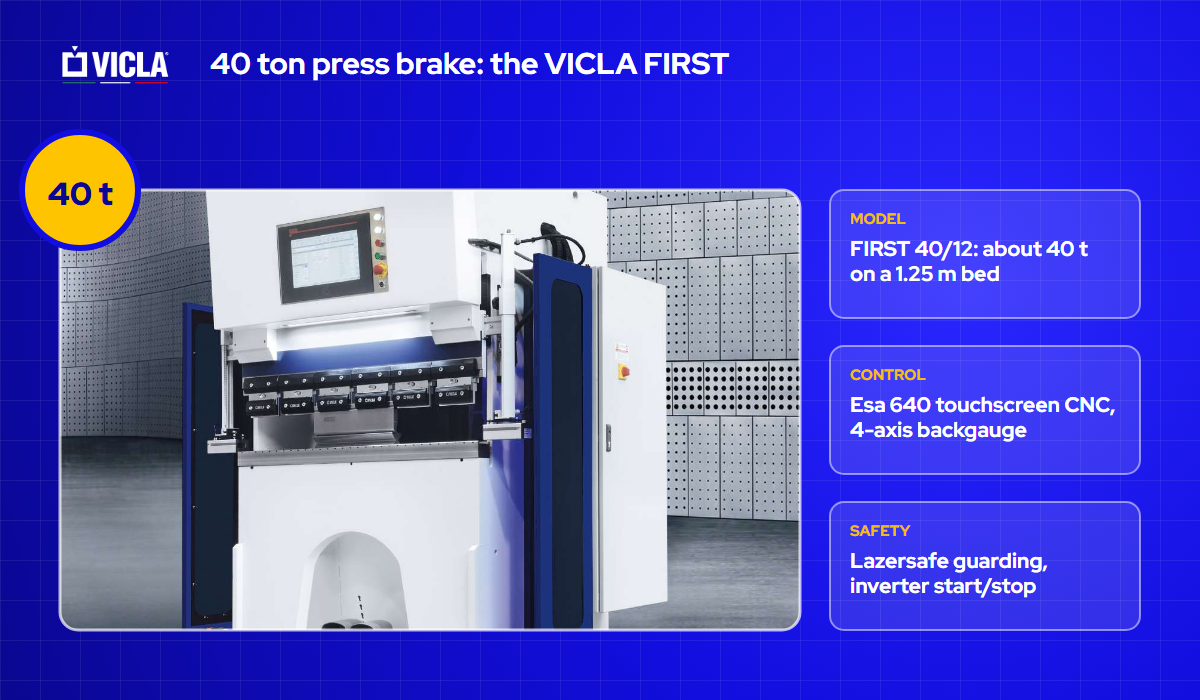
For light, small-part work VICLA offers the compact VICLA FIRST press brake, with an Esa touchscreen CNC, a 4-axis backgauge and Lazersafe guarding in a small footprint. Pair the tonnage with a bed length that fits your longest real part.
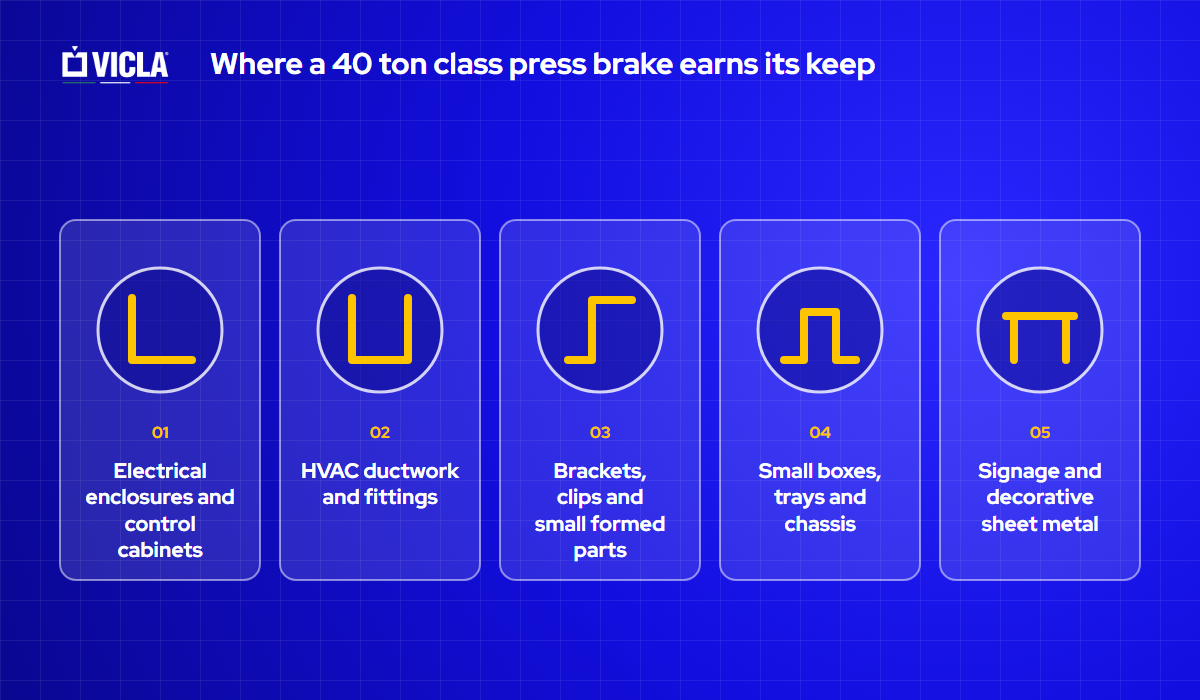
For enclosure and light-gauge work a 30 to 40 ton machine is usually plenty. Do not reach for more tonnage than your thickness needs, since an oversized machine costs more and offers no benefit on thin sheet. Start from your heaviest and longest real bend, add a sensible margin, and confirm the numbers with a tonnage chart or your VICLA contact rather than guessing.
What can a 30 and 40 ton press brake bend? As a guide, around 4 mm mild steel over a short 1.25 m bed, and noticeably more on short bends, in thin mild steel, aluminium and light stainless. Always confirm against a tonnage chart for your exact material, thickness and die.
Is more tonnage always better? No. Oversizing wastes money and gives no benefit on thinner parts, while undersizing limits the work you can take. Match tonnage to your real part mix.
How does bend length change the tonnage I need? Force is spread along the whole bend, so a longer bend needs more tonnage. The same machine bends thicker material on a short bend than on a full-length one.
A robotic bending cell puts a 6-axis robot next to a CNC press brake and lets it load, bend and...
Two weeks ago we discussed how important it is to know the recurring problems of sheet metal...
Stainless steel's unique properties, such as its corrosion resistance, which we explain in detail...