Your first CNC press brake: a guide for small job shops
Your first CNC press brake is a big step up from manual folding, and a big cheque. The goal is to...

Bending length is one of the first decisions when you buy a press brake, and one of the easiest to get wrong. Too short and you cannot make your longest part. Too long and you pay for bed you rarely use. Here is how to size it sensibly.
Bending length is the usable width between the side housings, the longest bend the machine can make in one stroke. It is not the same as tonnage: a long machine can still be low in force, and a short one can be very powerful. You choose length for the size of your parts and tonnage for their thickness.
The longer the bend, the more force it takes, because tonnage is spread across the whole bend line. A 3 mm bend over 1 m needs far less force than the same bend over 3 m. That is why long beds usually come with higher tonnage: the two are sized as a pair, not separately.
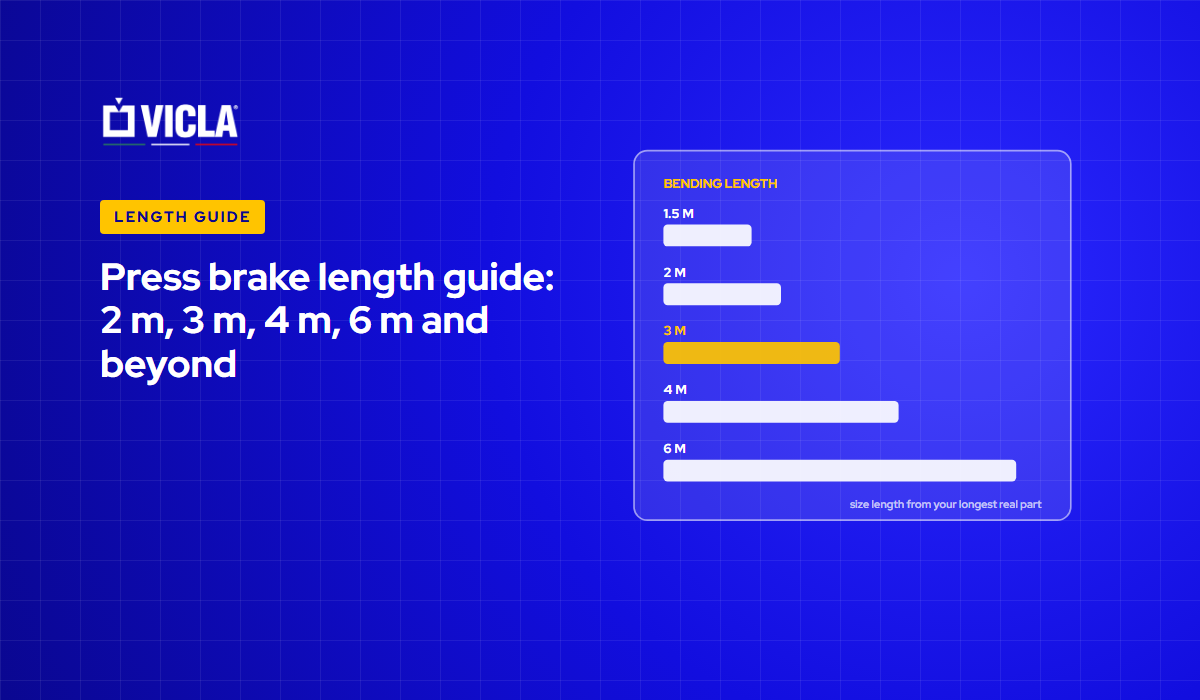
Start from your longest real part and add a margin for the backgauge and for parts you will take on tomorrow, not just today. Avoid buying a very long bed just to bend small parts occasionally, since a long machine costs more and uses floor space. If long parts are rare, a shorter, cheaper machine plus occasional outsourcing is often smarter. The VICLA range spans compact beds up to large structural lengths.
Yes, but you are paying for capacity you are not using.
Usually, because the force is spread over a longer line.
A reasonable margin is wise, but do not oversize on hypotheticals.
Your first CNC press brake is a big step up from manual folding, and a big cheque. The goal is to...
Choosing a press brake can seem daunting at first, but it really boils down to understanding the...
Here is the whole set of everyday press brake bending formulas on one page, with what each symbol...