Automatic tool changers for press brakes
Setup is the hidden cost of bending. Every time an operator strips and rebuilds the tooling for a...

Automating bending is a serious investment, so the right question is not whether it is impressive but whether it pays. The good news is that the payback is straightforward to estimate. Here is how.
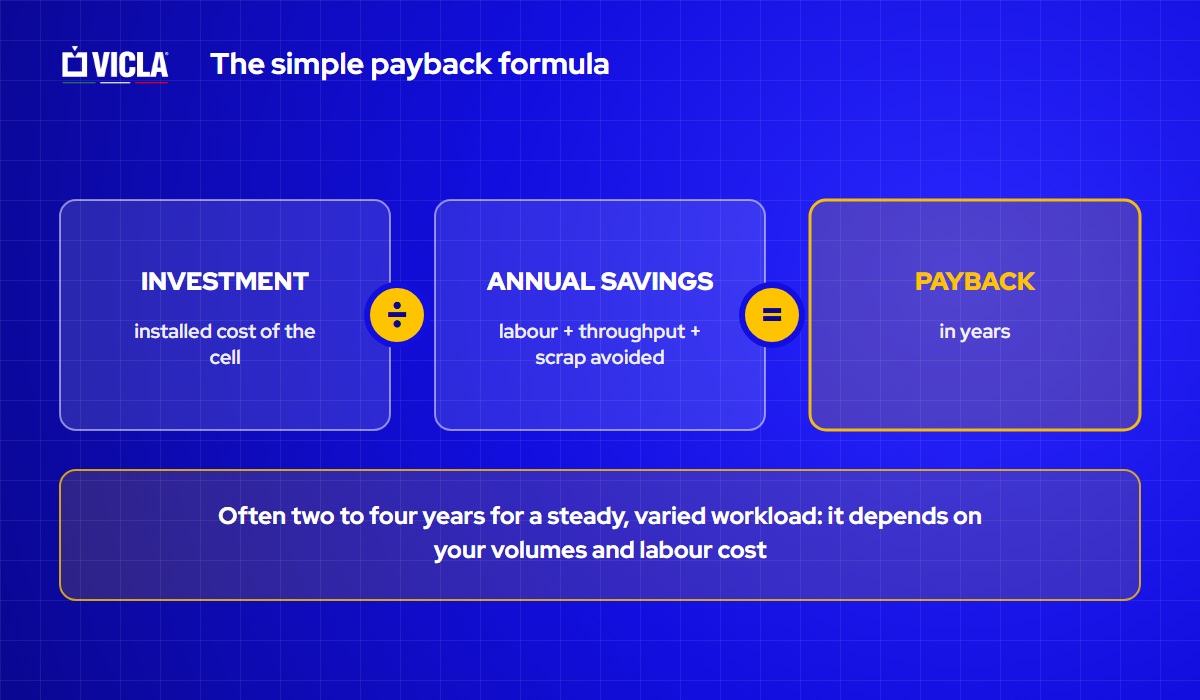
Payback (years) = Investment / Annual savings
If a robotic cell costs a given amount and saves a given amount each year, the ratio tells you how long before it has paid for itself. Most shops look for a payback inside a few years.
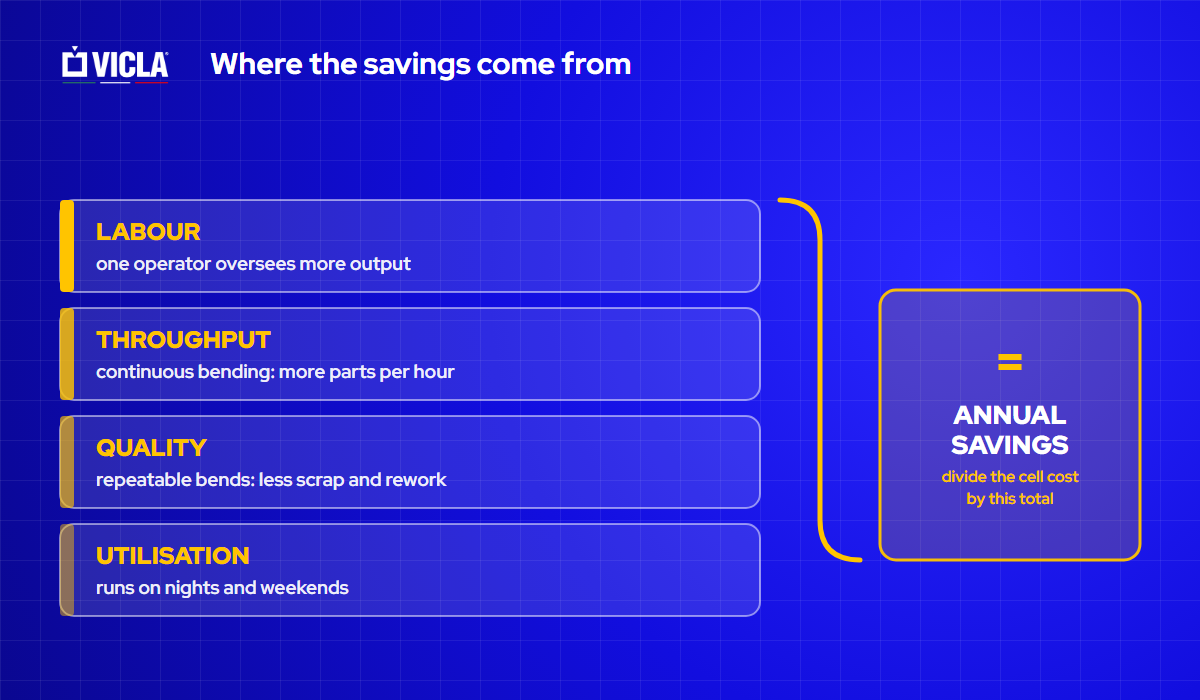
Add up the annual savings: labour hours freed times their cost, plus the value of extra parts produced, plus scrap avoided. Divide the cell's installed cost by that total. For a varied, steady workload the result is often a payback of two to four years, after which the saving is profit.
Automation pays best with medium to high volumes, repetitive parts, multi-shift demand and rising labour cost. It is a weaker fit for one-off parts and very low volumes, where manual flexibility wins. If your bending is a bottleneck and labour is tight, the case is usually strong.
The VICLA MATRIX robotic cells are built to run unattended with consistent quality, and the hybrid machines inside them also cut energy cost, which improves the payback further. Share your part mix and volumes and VICLA can model the case with you.
Often two to four years for a steady, varied workload, but it depends entirely on your volumes and labour cost.
It suits repetitive, steady work. With tool change and smart software it also handles small batches.
Usually labour and utilisation, from running with less supervision across more hours.
Setup is the hidden cost of bending. Every time an operator strips and rebuilds the tooling for a...
An ageing press brake that still bends straight is a tempting thing to keep. The question is...
Bending length is one of the first decisions when you buy a press brake, and one of the easiest to...